

A Controlled, Auditable Security Model for AI Agents
ERP Suites AI Agents run on the ERP Suites AI Platform within OCI, securely interacting with JD Edwards without exposing credentials, bypassing security, or moving data outside your environment. The platform is designed with a defense-in-depth model, ensuring:
- Data stays within OCI
- Actions are controlled & auditable
- Access respects your JDE security model
How Are AI Agents Secure in JD Edwards?
JD Edwards AI agents are designed with a clear principle:
The agent is not trusted by default.
Instead of introducing a new access layer, the AI operates as a controlled execution layer within your existing JDE security model.
User-Bound Identity, Not Independent Access
AI agents do not operate as their own users or with elevated privileges.
Every action is performed on behalf of an authenticated JD Edwards user, ensuring:
- Actions align to known identities
- Permissions are enforced at the user level
- No expansion of authority beyond what is already defined
No Stored Credentials or Persistent Access
User credentials are never stored or exposed.
Access is managed through secure, session-based authentication using short-lived tokens, ensuring that:
- Access is temporary and controlled
- There is no persistent credential risk
- Sessions are tied directly to authenticated users

Constrained Execution Paths
AI agents cannot take arbitrary actions.
Every request must map to:
- Approved JD Edwards functions
- Defined orchestrations
If an action does not meet these constraints, it is denied.
This ensures AI operates within strict, predefined boundaries.
Data Stays Within Defined Boundaries
JD Edwards remains the system of record, with controlled and limited data movement.
Each customer operates within a dedicated OCI environment with strict isolation boundaries, ensuring:
- Data is never shared across tenants
- Customer data is not used to train public models
- Data remains fully contained within its environment
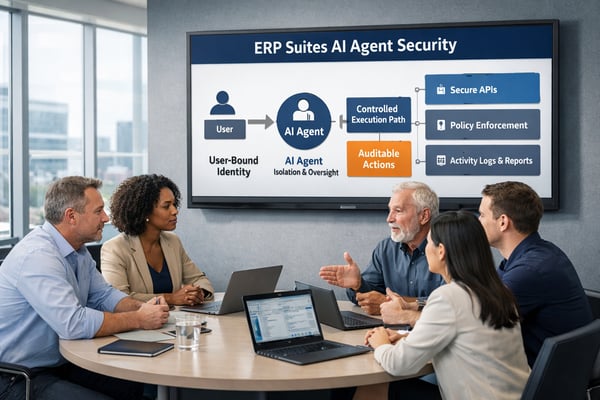
Full Auditability and Traceability
Every interaction is tracked.
From the initial request to the final action, the system ensures:
- Complete visibility into what occurred
- Traceability of actions back to the user
- Support for governance, compliance, and auditing
A Controlled AI Model
The role of the AI agent is clear:
It helps execute permitted work. It does not expand authority or bypass controls.
This ensures AI enhances productivity while remaining fully aligned with existing ERP governance and security frameworks.

How the Agent Works in Defined Security Framework
Every AI agent interaction follows a defined, secure path, ensuring actions are validated, permitted, and fully traceable. Rather than operating independently, the agent acts on behalf of an authenticated user and executes only through approved functions and orchestrations. This controlled framework helps ensure AI remains aligned with existing JD Edwards security controls from request through execution.
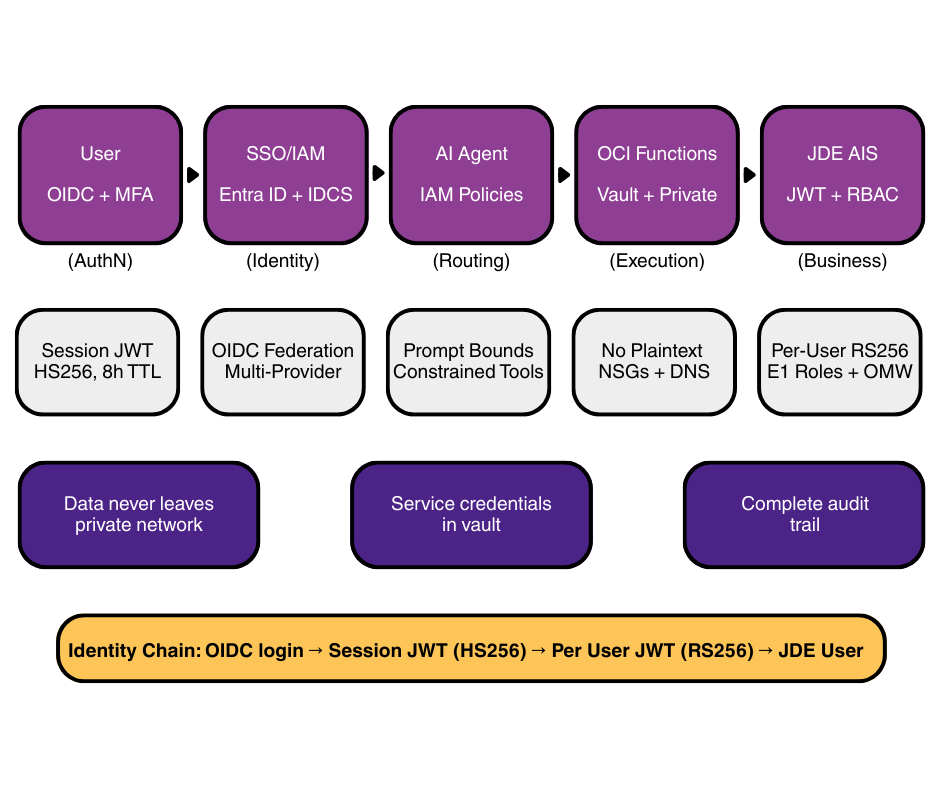
User Authenticates
The process begins with a verified user. Authentication is handled through secure login methods, establishing a session tied to that user.
AI Interprets the Request
The AI agent receives and interprets the user’s request. It does not act independently—it operates on behalf of the authenticated user.
Permissions Are Enforced
Before any action is taken, the request is checked against:
- User’s JDE permissions
- Defined roles and access controls
If the user is not authorized, the action does not proceed.
Action Is Routed Through Approved Paths
All actions must map to:
- Approved JD Edwards functions
- Defined orchestrations
Requests that fall outside these paths are denied.
Action Is Executed Within Boundaries
If approved, the action is executed within the system, without bypassing existing controls or expanding authority.
Everything Is Logged and Traceable
Every step, from request to execution, is recorded. This ensures full visibility, auditability, and accountability for all actions.
How JD Edwards AI Agent Security Compares
Not all AI solutions are built to operate within JD Edwards security controls. Without the right architecture, this can introduce risk around execution, permissions, and visibility.
Security Area
ERP Suites' Solution
JD Edwards AI Agents
Uncontrolled AI Solution
Identity
Agent acts on behalf of an authenticated user
AI operates without clear user mapping
Permissions
Enforces existing JD Edwards user permissions
Actions may not align to defined user roles
Execution Control
Only approved functions and orchestrations are allowed
Actions may occur without defined boundaries
Access Layer
Operates as a controlled execution layer
Can become an invisible or uncontrolled access point
Data Handling
JD Edwards remains the system of record with strict data boundaries
Data movement and usage may be unclear
Credentials
No persistent human credentials; uses short-lived tokens
Potential reliance on persistent credentials
Auditability
Full traceability of every request and action
Limited visibility into actions and outcomes
ERP Suites' Solution
JD Edwards AI Agents
Uncontrolled AI Solution
Identity
Agent acts on behalf of an authenticated user
Permissions
Enforces existing JD Edwards user permissions
Execution Control
Only approved functions and orchestrations are allowed
Access Layer
Operates as a controlled execution layer
Data Handling
JD Edwards remains the system of record with strict data boundaries
Credentials
No persistent human credentials; uses short-lived tokens
Auditability
Full traceability of every request and action
Identity
AI operates without clear user mapping
Permissions
Actions may not align to defined user roles
Execution Control
Actions may occur without defined boundaries
Access Layer
Can become an invisible or uncontrolled access point
Data Handling
Data movement and usage may be unclear
Credentials
Potential reliance on persistent credentials
Auditability
Limited visibility into actions and outcomes
What This Means for Your Team
Your team can adopt AI agents without introducing a new layer of uncertainty because actions remain governed, visible, and aligned with your existing JD Edwards environment.

Operate AI Without Introducing New Risk
AI agents can take action inside JD Edwards, but within a model your team already understands and controls.
No New Access Model to Manage
AI operates within your existing users, roles, and permissions, so your team doesn’t need to redefine how access is governed.
No Loss of Visibility Into System Activity
Every action remains tied to a user and can be traced, so your team can maintain oversight of what is happening in the system.
No Uncertainty Around Data Handling
Data stays within controlled boundaries, so your team knows where data resides and how it is used.

AI Learning Center
Check out the latest blogs, videos, and more from ERP Suites experts.
Common Security Questions
Can an AI agent perform actions a user is not authorized to do?
No. The AI agent operates on behalf of an authenticated user and is restricted to that user’s existing JD Edwards permissions. It does not expand authority.
Does the AI agent have its own system access or credentials?
No. The agent does not operate as an independent or privileged identity. It uses secure, session-based access tied to the authenticated user.
Are user credentials stored or exposed?
No. Human credentials are not stored. Access is managed through short-lived tokens within a secure session.
Can the AI agent execute any request it receives?
No. All actions must map to approved JD Edwards functions or orchestrations. If a request falls outside those boundaries, it is denied.
Where does the data go during AI processing?
JD Edwards remains the system of record. Data movement is controlled and limited, and customer data is not used to train public models.
Can AI actions be tracked and audited?
Yes. Every request and action is logged, ensuring full traceability and visibility for governance and compliance.
Does the AI bypass existing ERP security controls?
No. The AI operates within existing JD Edwards security controls and does not introduce a separate or hidden access layer.
What prevents unintended or unsafe actions?
Actions are constrained through defined execution paths, business rules, and orchestrations, ensuring they stay within approved boundaries.
How do we prove compliance (SOC 2, etc.)?
Compliance is supported through OCI’s SOC 2 and ISO 27001 certifications, JD Edwards’ compliance framework, and full audit trails across all layers. Customers control data residency, and architecture documentation is available for auditors.
Can employees see data they shouldn’t?
No, multiple layers prevent unauthorized access, including identity authentication, controlled operations, JDE role-based security, row-level restrictions, and full audit logging.
Is customer data used to train AI models?
No, your data is not sent to OpenAI or Anthropic; it remains securely within OCI with no external sharing, storage, or use for training.